Saturday, January 11, 2014

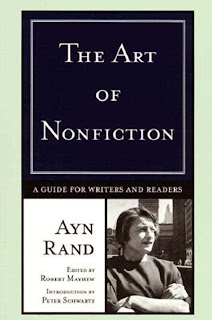
BOOK REVIEW: “The Art of Nonfiction” by Ayn Rand


Developing writers and interested biographers should listen carefully when a celebrated author is talking about writing, and Ayn Rand’s The Art of Nonfiction is no exception. Talking about writing is the operative phrase here, as this book is actually a collection of recorded lectures from a course Rand led for friends and associates in 1969. But readers should not feel cheated. At age 64, Rand had written much, including all four of her novels, two of them, Atlas Shrugged and The Fountainhead, ranking at numbers 1 and 2 on the Reader’s List of 100 Best Novels of the Modern Library. She also created a dozen nonfiction books and essay collections, many plays and screenplays, and her own philosophical system, objectivism, which figures prominently in all her work. In any context, her ideas on the creative process are well worth a listen.

The wisdom Rand gained from her writing experience is unique, and she evokes it engagingly. She begins with an encouraging premise: “Contrary to all schools of art and esthetics, writing is something one can learn. There is no mystery about it.” Her walk through the writing process may seem to take a traditional route at first glance, as she divides her topics among the usual chapters of creating an outline, writing the draft, and editing. Along the way, however, appears her uncompromising worldview. How else would a chapter “Applying Philosophy Without Preaching It” show up in such a discussion?

Rand’s objectivist inclinations are unmistakable in virtually every utterance. She says, “Writing is an unpredictable process; it does not proceed regularly at so many words per minute.” With this mindset, she tackles moments in the writing process in her singular way: “There are two separate jobs: the job of thinking and the job of expressing your thoughts. And they cannot be done together. If you try, it will take you much longer, and be much more painful.” She sees writing the first draft as a subconscious activity and editing as a conscious one, requiring “a switch to … a different mental set.”

Far from remaining on a purely philosophical plane, she systematically explains how her method works. Her chapter on editing tenders several practical tips, and her outlook on style is refreshing. “The first thing to remember about style is to forget it,” she writes, accepting that style is so difficult to learn and teach. This realization does not prevent her from dedicating a 40-page chapter to a discussion on how it emerges in several published passages.

Authors who contend with writer’s block can benefit from adopting Rand’s viewpoint. She uses an interesting term to describe it: the squirms. Embracing the squirms as a necessary part of any creative process, she implies that they are not a cause to give up writing but to understand and exploit what’s driving them at the service of the manuscript. And she practiced what she preached, rarely diverting herself from the composing task at hand: “When I was writing Atlas Shrugged, I accepted neither day nor evening appointments with rare exceptions, for roughly thirteen years. “

Understandably, readers might be put off by two problems in this book. Rand frequently references fiction to describe the task of an essayist, even though she sees significant differences between the two genres. Also, she constantly returns to her own fiction to illustrate examples of excellent writing during her talks.

In Rand’s defense, during these lectures she was speaking to devotees, who benefited from references to her familiar prose. In addition, she did not intend to see these lectures in print. Even if she did, she had no hand in their print version, as it was edited by Robert Mayhew and published in 2001, nearly two decades after her death. Being above all else a logical and practical thinker, Rand likely would have changed some the illustrative texts to reach a wider audience if she wrote it herself.

Nevertheless, the presence of her narrative passages does the book no harm. In fact, Rand fans will enjoy the autobiographical aspects of the book. For instance, she admits to being weak at titling books, crediting her husband Frank O’Connor for coining the title Atlas Shrugged (She wanted to call it The Strike.)


Those who are likely to pick up such a book will not be disappointed. A lot of gems are to be found within the 192 pages of The Art of Nonfiction.

Saturday, January 04, 2014

A Touch of the Poet: On Writing an Acknowledgment

I celebrate the ninth anniversary of WORDS ON THE LINE with a gem from one of my writing students, Joseph N. Kennedy, Superintendent of MTA Bus Company's Queens North Road Operations, at the Casey Stengel Depot, Flushing New York. Joe, who attended a four-week writing class that I led for New York City Transit Department of Buses, was a great student. He is relentlessly good-humored in his comments, deeply committed to his job, appropriately opinionated during class discussions, and consistently correct during writing exercises. Most importantly, he is a solid guy: he is a man of his word.

During an email exchange in which we were expressing best wishes for the new year, I wrote a modest poem to him and some of his colleagues:
Haven't heard too many customer fusses
Since you folks are managing Buses.
The riders won't for too long chafe,
Cause when they're riding, they feel safe.
 So for all the great things you guys do.
I wish a great 2014 to you.
Here is how Joe responded:
Phil,
In response, please note:

When I was instructed by mail to attend your class,
I figured it would be boring.
I assumed I would go, and sit on my ass,
And likely end up snoring.

To my surprise, and much to my delight,
I discovered quite the contrary,
You challenged us until we got it right,
I related this to my wife Mary.

I looked forward to going on Tuesday morning,
And tried hard not to be late.
I apologize that I gave no warning,
when I arrived a little past eight.

When class was over, and we were sent on our way,
I admit to being disappointed,
Although I must now proudly say,
My writing skills are anointed.

When people now comment on the strength of my prose,
How it is wonderful and not at all shallow,
I simply reply with wrinkle of my nose,
I owe it all to Phil Vassallo!


Now if that's not a reason to go on teaching forever, I don't know what is. Joe closed his masterpiece by writing "My apologies to all poets past and present." The truth is that Joe did the poets proud. I told him that the student outdid the teacher. 

I share this gem not to brag about the praise I received, but to underscore the power of writing an acknowledgment. I tell people that a thank-you note should contain three elements:

  • Purpose – the reason you are expressing gratitude
  • Value – the impact that the person has had on you
  • Commitment – the enduring connection between you and the person

The first three stanzas of Joe's poem express the purpose, the fourth stanza states the value, and the last stanza asserts the commitment. It is a perfect acknowledgment, one that I will always remember. So if you want to write an acknowledgment, remember these elements and especially Joe's poem. 

Thanks, Joe. You are a class act.

Saturday, December 28, 2013

WORDS ON THE LINE: Nine Years Later

This post, the 553rd of this blog, ends the eighth year for WORDS ON THE LINE. Since the first post on January 4, 2005, I have focused on ways to help readers become better writers, through book briefs, references, and websites, which cover useful writers' resources; and points on writing theory, style, grammar, email, and much more.

If you ever have a question, you can reach me at Phil@PhilVassallo.com. Here's to a productive 2014 as a writer!

Saturday, December 21, 2013

Writing from Your Heart

Here's a quick anecdote for anyone considering writing as a 2014 resolution.

A gentleman (let's call him Sergei) in one of my recent classes used a proposal-writing assignment as an opportunity to write an open letter to the American Society of Civil Engineers (ASCE) arguing for improved structural engineering education in the United States. Sergei was an engineer in Russia, where he says structural foundations received greater emphasis on the undergraduate level. Now an American citizen living in New York for the past decade, he saw vast differences in the engineering education he received in Moscow from the one his son was receiving in New York. The idea of his proposal was for the ASCE to become at the least a change agent for the way the USA approaches engineering science. 

While his choice of audience and the sweep of his proposed changes were ambitious to say the least, I encouraged him to complete the assignment and send it to the ASCE for two rhetorical reasons, one of them practical and the other theoretical. The practical one is self-evident: he needed practice writing in English. The theoretical reason is no less important: what moves you to write will improve your writing.

As you resolve to improve your writing in the coming year, hold fast to those issues that inspire you, regardless of what they are. They may concern child care, democracy in Turkey, sex trafficking in the Middle East, gun control in the US, the rising popularity of chess in Asia, improved workplace safety—it doesn't matter as long as you are inspired to write. Just do the research, write about what you know, and I promise, you will see the results.

Saturday, December 14, 2013

Thanks to My Teachers, Part 8; J. J. Chambliss

At the Rutgers Graduate School of Education, I studied three disciplines within educational theory: philosophy, history, and sociology. Of the professors I met there, one stands out for his high quality scholarship, his deep commitment to education, and his genuine concern for students: J. J. Chambliss.

His book Educational Theory as a Theory of Conduct: From Aristotle to Dewey (State University of New York Press, 1987), is a concise collection of 12 essays that serves as an excellent starting point for students interested in the history of Western education. His ability to provide the historical underpinnings of contemporary educational topics never ceased to amaze me. 

Chambliss, now Professor Emeritus, had a reservoir of knowledge that seemed boundless, and his classroom lectures on Comenius, Condillac, and Comte remain models of content mastery.

Monday, December 09, 2013

Thanks to My Teachers, Part 7: James M. Giarelli

When I was in a doctoral program in educational theory at Rutgers University in the 1990s, obtaining a degree was my third in a long list of priorities for attending graduate school.

My first reason for enrolling in the Graduate School of Education was probably the opposite of what most students enrolled there would say. I wanted a stronger theoretical foundation. I felt that I was intuitively a good teacher, but I was weak in pointing to the theoretical foundations that supported my approach. I achieved that goal by reading twice as much as the requirements on the educational philosophies Plato, Aristotle, Augustine, Aquinas, Erasmus, Vico, Dewey, Freire, and many others whose concepts preceded the trendy ideas of today by centuries. 

My second reason was publication. I intended to make publishable essays of my class assignments. This decision made me do more than triple the work that professors expected of their students. For instance, if an assignment called for a 500-word summary of  Quintilian's Institutes of Oratory (95 CE), I would also contrast it with Comenius's The Great Didactic (1638 CE), leading to a 5,000-word essay, because the more exhaustive research would appeal to academic journals interested in publishing the piece. Needless to say, such a practice would annoy most professors, who just wanted to do the minimum in developing their students' perspectives and wisdom. Not James M. Giarelli, who patiently gave feedback and guided me through to my dissertation, which was as much as three times longer than my peers' work. The result was publishing more than a dozen articles in various professional and scholarly journals.

That third reason, actually getting the doctorate, has proved useful in my career. But if I had not achieved the first two aims, the third would have never happened. 

Wednesday, December 04, 2013

Thanks to My Teachers, Part 6: Sondra Perl

Sondra Perl was one of my teachers when I was studying the writing process in a graduate program at Lehman College in The Bronx, New York. Her contributions to writing theory earned her a Guggenheim fellowship, and more importantly, she was a great encouragement and positive force in her students' lives.

Perl's composing guidelines make a lot of sense, so I encourage you to read them if you struggle when writing. These tips can make the difference between abandoning and completing a writing project. Thank you, Professor Perl.